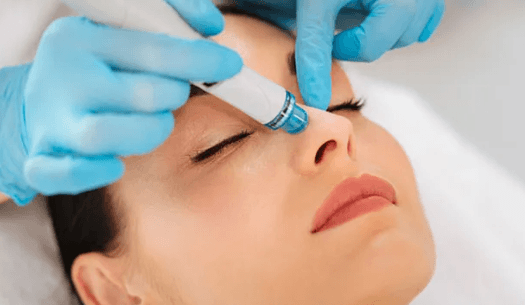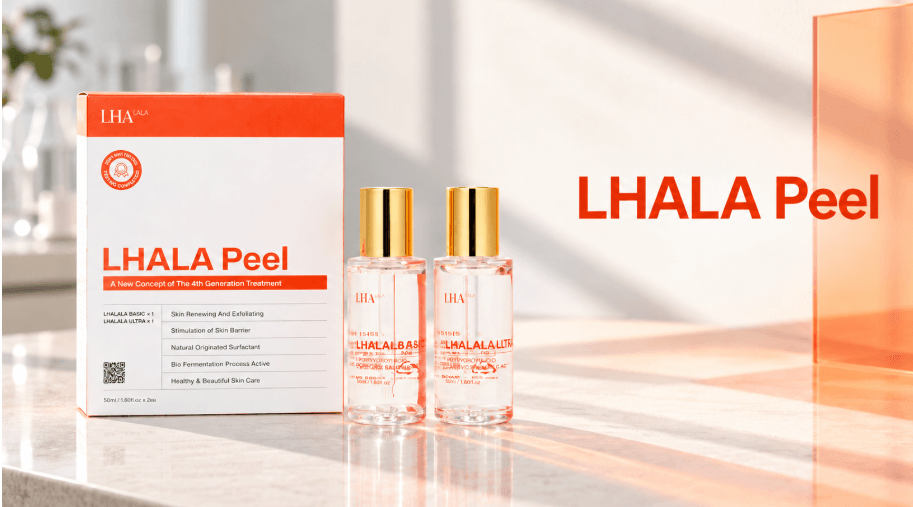
Product illustration.
The word “peel” often brings to mind obvious flaking and several days of hiding irritated skin. Yet many people interested in professional exfoliation want something more modest: a smoother surface, a less dull appearance and skincare that sits comfortably. Lhala Peel attracts attention because its product concept addresses that desire for refinement without making visible shedding the main attraction.
At the center of Lhala Peel is lipohydroxy acid, usually called LHA. The brand combines it with its proprietary H2sol technology and a lipid-focused formulation concept. Together, these elements position the product around surface renewal and skin comfort, two priorities that can otherwise seem to compete in an exfoliating treatment.[1]
The appeal is easy to recognize when roughness and dullness are the main complaints. Refining the outer surface can matter more to that customer than changing facial shape. The desired result is skin that looks more even and feels comfortable, rather than a dramatic amount of visible shedding.
LHA and the outer skin surface
LHA is capryloyl salicylic acid, a modified form of salicylic acid. Its lipid affinity distinguishes it from an ingredient such as glycolic acid and helps explain interest in LHA for exfoliation and comedonal concerns. “Comedonal” refers to the blocked-pore lesions commonly described as blackheads and whiteheads, rather than every type of inflamed acne.[2]
Exfoliation concerns the release of cells from the skin’s outer surface. For a customer, the point is the resulting surface quality, not the spectacle of peeling. A rough-looking cheek can make light and makeup reveal texture unevenly. Refining that surface is a different goal from filling a deep depression or changing the position of facial tissues.
LHA’s chemical identity does not by itself predict the strength of a finished peel. The concentration, vehicle and overall formulation matter. That is why a comparison between acid names cannot tell someone which treatment will feel gentler or produce the best result for their particular skin.
Nor should the development of LHA by ingredient researchers be confused with proof for every commercial product containing it. Lhala Peel brings a specific branded approach to an existing ingredient concept. Its appeal is easier to understand when the ingredient science explains the idea, while the finished product remains responsible for its own performance claims.
Surface renewal and skin comfort play different roles
H2Medi describes Lhala Peel through the combination of LHA, H2sol and lipids. LHA supplies the recognizable exfoliating ingredient, while H2sol is the brand’s proprietary technology name.[1] The lipid emphasis introduces another priority: maintaining a comfortable surface as older outer cells are released.
The outermost skin layer is not simply a pile of unwanted dead cells. It consists of flattened cells surrounded by organized lipids. Those lipid layers play a major role in limiting the passage of water through the skin surface. Molecular simulations by Das and colleagues demonstrate how the organization of skin lipids creates a barrier to water movement.[6] This is general barrier science, not a test of Lhala’s formula, but it explains why the condition of the remaining surface matters during exfoliation.
Surface renewal and moisture retention therefore involve different structures. Releasing cells at the surface concerns exfoliation; preserving an effective surrounding barrier concerns water control. Think of the difference between smoothing a surface and keeping that surface comfortable afterward. A rough patch becoming less apparent would be an incomplete success if the skin simultaneously felt persistently tight or irritated.
Lhala’s combined positioning reflects this balance rather than treating maximum peeling as the only objective. It does not establish that the product recreates the skin’s natural lipid arrangement, or that everyone will tolerate it identically. The familiar Basic and Ultra names identify paired formulations within the system. They are parts of its product design, not a universal scale on which Ultra must deliver a better result for every customer.
How LHA compares with AHA and BHA
Glycolic acid is a common alpha hydroxy acid, or AHA. Salicylic acid is commonly grouped as a beta hydroxy acid, or BHA. LHA is related to salicylic acid but has its own chemical structure. These distinctions are useful because they explain why different exfoliating products can behave differently, even when their marketing promises sound almost identical.
The categories are not a ladder on which every newer name is automatically better. In a split-face trial involving 50 women, Oresajo and colleagues compared an LHA peel with a glycolic acid peel for fine lines and hyperpigmentation. The results did not show a statistically significant difference between the groups. That study gives LHA a credible research context without establishing universal superiority or a Lhala-specific result.[3]
| Option | Ingredient focus | Main discussion point | A misleading shortcut |
|---|---|---|---|
| Lhala Peel | LHA within a branded multi-component system | Surface refinement alongside comfort-focused positioning | “Gentle” guarantees no reaction |
| Other LHA peels | Capryloyl salicylic acid in their own formulations | The formulation and concern studied | Every LHA product reproduces the same trial results |
| Glycolic acid peels | An AHA used in superficial resurfacing | Texture and tone goals within the chosen peel design | AHA is always harsher or less effective |
| Salicylic acid peels | A lipid-soluble exfoliating acid | Congestion and the particular type of acne concern | All breakouts respond in the same way |
For customers, the useful comparison is specific. Is the priority uneven surface texture, visible congestion or a pigment-related concern? How much short-term disruption is acceptable? A thoughtful answer to those questions is more valuable than ranking every acid by a “generation” label or assuming the newest product replaces all earlier options.
What smoother brighter looking skin can mean
Lhala Peel is most coherently discussed through surface-focused goals. Roughness, a dull-looking finish and congestion are easier to connect to an exfoliation concept than dramatic lifting or deep scar correction. That focus gives the customer a recognizable reason for considering the product without turning it into a solution for unrelated concerns.
“Glow” needs interpretation. It is a visual description, not a single biological measurement. A smoother surface, the finish of accompanying skincare and changes in lighting can all influence how a photograph looks. A pleasing immediate appearance may be real, but it should not automatically be described as new collagen, permanent pore reduction or complete barrier repair.
The same applies to brightness. Skin can appear fresher without a measured reduction in pigmentation. A persistent dark patch is a more specific concern than general dullness and deserves a more specific assessment. That distinction helps prevent a broad radiance claim from being mistaken for a promise to treat every discoloration.
For someone whose main complaint is visible pores, the goal also needs precision. Reducing congestion or improving the surrounding surface can be a different aim from changing the pore itself. A useful product discussion describes the appearance it seeks to improve and avoids suggesting that pores should disappear from healthy skin.
These distinctions make modest outcomes meaningful. Skin that looks more even under everyday lighting or feels less rough can be a worthwhile result without being presented as a complete transformation.
What LHA studies have measured
In a small randomized split-face study, Levesque and colleagues compared LHA and salicylic acid peels in 20 people with comedonal acne. Both sides showed reductions in noninflammatory lesions, with no significant difference between the peels. The study did not demonstrate a significant reduction in inflammatory lesions. This supports a focused conversation about congestion, rather than treating “acne” as one uniform outcome.[2]
Earlier research by Piérard and colleagues examined tissue changes after a beta-lipohydroxyacid formulation in six volunteers. It found changes related to epidermal renewal and thickness. Such exploratory work helps explain scientific interest in the ingredient, but its small scale and different formulation do not establish that Lhala Peel lifts skin or produces a predictable amount of collagen.[4]
For the person considering Lhala Peel, the practical message is that an ingredient can have a sound rationale while the expected benefit remains specific and limited. Texture, congestion, pigmentation and firmness should not be blended into one catch-all promise simply because all four appear in beauty marketing.
The American Academy of Dermatology also distinguishes chemical peels by their depth and explains that healing and visible reactions vary. Lhala’s gentler positioning should therefore guide a discussion about comfort, not guarantee that every skin type will have the same experience.[5]
When surface refinement is the priority
The conversation is especially relevant to someone interested in surface refinement who dislikes the idea that a successful peel must cause dramatic shedding. It is less well framed around a demand for instant lifting, removal of deep scars or a cure for persistent inflammatory skin disease.
A useful consultation begins with the concern that appears in ordinary life. Does makeup emphasize rough areas? Is the complexion generally dull, or is there one clearly defined dark mark? Are the bumps mostly clogged pores, or painful inflamed lesions? Those distinctions help a practitioner explain whether exfoliation is the right topic at all.
Comfort is also a real outcome. Someone with easily irritated skin may value an approach only if it leaves the skin feeling manageable. Calling a product gentle does not remove the need to consider current sensitivity, recent procedures and existing skincare. The aim is a good match between the person’s skin and the product concept, rather than choosing the strongest-sounding option.
The format itself is straightforward: the brand lists Basic and Ultra as a paired presentation, with 50 mL in each bottle. This identifies the system but does not establish an individual treatment amount, a number of visits or an expected result.[1]
Frequently asked questions
Is Lhala Peel just another name for salicylic acid
No. Its LHA component is capryloyl salicylic acid, a derivative of salicylic acid. Lhala Peel is a finished branded system that combines this ingredient with other formulation elements. The ingredient relationship is useful, but the names are not interchangeable.
See also: Best Specialist for exosomes hair therapy in islamabad
Must my skin visibly peel for the treatment to work
Visible shedding is not a reliable customer scorecard for success. The meaningful question is whether the intended concern improves while the skin recovers appropriately. A dramatic reaction should not be treated as proof of a better result or greater value.
Can it remove blackheads and inflammatory acne equally well
Those are different concerns. The small comparative LHA trial supported an effect on comedonal lesions but did not show a significant reduction in inflammatory lesions. It also studied another formulation. Persistent inflamed acne warrants a specific clinical discussion rather than a general glow treatment promise.[2]
Is it automatically suitable for sensitive skin
No single label establishes suitability for everyone. Sensitivity can describe several different experiences, from occasional stinging to an active skin condition. The product’s comfort-focused positioning is relevant, but the person’s current skin and history still determine the decision.
Will it make my pores disappear
That is not a realistic goal. Pores are normal skin structures. It is more useful to discuss visible congestion and surrounding texture, then judge whether their appearance changes, instead of expecting an edited, pore-free finish.
Does peel and fill mean it works like an injectable filler
No. A phrase describing the brand’s renewal concept should not be interpreted as evidence of injected volume replacement. Surface refinement and a smoother-looking complexion are different goals from restoring projection or correcting a structural contour deficit.
Explore the Lhala Peel system
Professionals can explore the Lhala Peel system through MJS Beauty. Its distinguishing combination is an LHA-based exfoliation concept alongside comfort-focused formulation elements. For customers interested in a more refined surface, the useful balance is smoother-looking texture with skin that continues to feel comfortable.
References
[1] H2Medi / LHALALA. Brand Story and LHALA Peel: Official Product Information. Undated; accessed 2026.
[2] Levesque A, Hamzavi I, Seite S, Rougier A, Bissonnette R. Randomized Trial Comparing a Chemical Peel Containing a Lipophilic Hydroxy Acid Derivative of Salicylic Acid with a Salicylic Acid Peel in Subjects with Comedonal Acne. Journal of Cosmetic Dermatology. 2011.
[3] Oresajo C, Yatskayer M, Hansenne I. Clinical Tolerance and Efficacy of Capryloyl Salicylic Acid Peel Compared to a Glycolic Acid Peel in Subjects with Fine Lines/Wrinkles and Hyperpigmented Skin. Journal of Cosmetic Dermatology. 2008.
[4] Piérard GE, Nikkels-Tassoudji N, Arrese JE, Piérard-Franchimont C, Lévêque JL. Dermo-Epidermal Stimulation Elicited by a Beta-Lipohydroxyacid: A Comparison with Salicylic Acid and All-Trans-Retinoic Acid. Dermatology. 1997.
[5] American Academy of Dermatology. Chemical Peels: FAQs. Undated; accessed 2026.
[6] Das C, Olmsted PD, Noro MG. Water Permeation through Stratum Corneum Lipid Bilayers from Atomistic Simulations. Soft Matter. 2009.