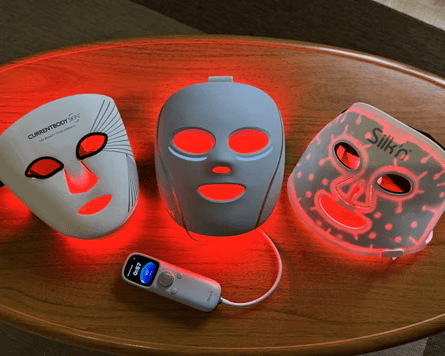
LED light therapy is one of the few skincare technologies where the science has strengthened rather than faded under scrutiny. The problem for most buyers is not whether it works, but the price of entry. Flagship masks from the best-known brands sit between $400 and $800, which is a considerable amount to commit before you know whether the routine suits you.
The good news is that the specifications that determine results are not exclusive to the top of the market. Wavelength accuracy, power density and coverage are all achievable well below $400, and several devices in that bracket deliver output identical to masks costing three times as much. The bad news is that the budget end also contains a great deal of genuine junk, including masks that never publish a single wavelength figure. Below are five affordable options that hold up, ranked on what they actually deliver.
What Actually Matters at This Price
Published wavelengths. This is the fastest way to separate a real device from a novelty. A credible mask states exact values in nanometres. Red around 630 to 660nm supports collagen and radiance, blue around 415 to 470nm targets acne-causing bacteria. A mask that lists only colour names is telling you nothing.
Irradiance. Power density determines how much therapeutic light reaches the skin. Roughly 30mW/cm² has become the working standard across the category, including on masks well above $400. Anything that declines to publish a figure is usually declining for a reason.
Coverage and fit. Light only treats what it reaches, and effectiveness drops sharply with distance. A mask that sits flush against the face will outperform a better-specified one that gaps at the jaw.
Whether you will actually use it. LED results are cumulative over weeks. The most sophisticated mask in the world does nothing from inside a drawer, so simplicity and comfort carry real weight at every price point.
1. RegenaLight LED Mask — Best Overall Value
RegenaLight · $149.99
The RegenaLight LED Mask takes the top spot for a straightforward reason: it delivers the same measured power density as masks selling for two to three times the price. Its irradiance is 30mW/cm², which is identical to the figure published by Omnilux for the Contour Face at $395 and by CurrentBody for its Series 2 at $469.99. On the single specification that governs how much therapeutic light reaches your skin, the gap between this device and the category’s premium names is nil.
It runs 143 medical-grade LEDs across seven colours, each with a published wavelength: red at 633nm for collagen and fine lines, blue at 415nm for breakouts, green at 525nm, yellow at 590nm, cyan at 490nm, white at 510nm, and a purple mode combining red and blue. That breadth is unusual below $200, where most devices offer red alone or red plus blue.
Operation is deliberately simple. It is fully wireless, with no app and no tethered remote. Hold the button to power on, tap to cycle colours, run a session of up to fifteen minutes, and charge over USB. Straps are included if you want to move around, or you can simply lie back. It is dual voltage, so it works anywhere, and it is UV-free.
The neck mask is the other reason it leads on value. The neck and décolletage age faster than the face and are almost universally neglected, largely because most brands sell neck coverage as a separate device. RegenaLight bundles its LED neck mask free with the face mask during current promotions, a piece valued at around $130 on its own.
The honest limitations are worth stating. At 143 LEDs the count sits below several rivals, and there is no dedicated near-infrared mode, so treatment concentrates on the upper layers rather than deeper tissue repair. It is also sold direct only rather than through retailers.
Best for: First-time buyers who want genuine specifications and broad colour coverage without a $400 commitment.
Key specs: 143 medical-grade LEDs, 30mW/cm² irradiance, seven published wavelengths, wireless one-button operation, sessions up to fifteen minutes, dual voltage, UV-free, one-year manufacturer warranty.
Pros
- Same 30mW/cm² output as masks costing two to three times more
- Seven wavelengths, all published in nanometres
- LED neck mask included free, a piece most brands sell separately
- Fully wireless with no app or remote to manage
- One-year warranty plus a satisfaction guarantee
- Over 1,500 reviews, with roughly 90 percent at five stars
Cons
- LED count lower than several rivals in this guide
- No dedicated near-infrared mode for deeper tissue work
- Available direct from the brand only
2. Skin Gym LED Pro Light Therapy Mask — Best Budget FDA-Cleared Option
Skin Gym · $299.99
If FDA clearance is a firm requirement rather than a preference, the Skin Gym LED Pro is among the more affordable devices to carry it. It covers three wavelengths, red, blue and near-infrared, in a flexible silicone shell that contours to the face reasonably well.
The near-infrared mode is the meaningful addition here, extending treatment beyond the surface layers in a way that colour-only masks do not. The trade-off is breadth: three wavelengths rather than seven, and at double the entry price of the leader.
Best for: Buyers who want near-infrared and formal clearance without moving into the $400 tier.
3. Shark CryoGlow — Best for Under-Eye Puffiness
Shark · $349.99
The CryoGlow is the only mask here that pairs LED therapy with active under-eye cooling, which produces an immediate de-puffing effect from the first session rather than the gradual improvement LED delivers over weeks. It is FDA-cleared, runs red, blue and infrared light, and offers four preset programmes developed with dermatologists, with clinical testing behind the ageing and clearing modes.
Two caveats matter. The cooling pads occupy the under-eye area during those treatments, so LED light cannot reach that zone simultaneously. The rigid shell is also bulky to store and sits further from the skin than flexible designs on some face shapes.
Best for: Anyone whose main complaint is morning puffiness alongside general tone.
4. Qure Q-Rejuvalight Pro — Best for Customisation
Qure · $399
Qure builds its mask around control. It is FDA-cleared, offers five wavelengths including near-infrared, and lets you target separate facial zones through an app. Sessions run three minutes, which makes consistency easy to sustain.
The reservation is reliability. A noticeable share of user reviews report battery, charging and app problems. When the device works, satisfaction is high; the risk is that it does not. The rigid construction also draws consistent criticism for comfort and for leaving gaps in coverage.
Best for: Users who want zone-level control and short sessions, and are comfortable with the reliability trade-off.
5. Omnilux Contour Face — Best Clinical Evidence
Omnilux · $395
At the top of this price bracket, Omnilux offers the deepest published evidence base in consumer LED. It uses 132 medical-grade LEDs delivering red at 633nm and near-infrared at 830nm at roughly 30mW/cm², holds FDA, CE and TGA certification, and its underlying technology has been examined in more than 40 peer-reviewed studies. The two-year device warranty is the longest here.
The scope is narrow by design. There is no blue light, so acne support would require a second device, effectively doubling the spend. The semi-rigid shell also suits some face shapes better than others.
Best for: Users focused solely on fine lines, firmness and tone who want the most documented option available.
Is a Cheaper LED Mask Worth It?
Below roughly $100, the category becomes genuinely unreliable. Many ultra-cheap masks use mixed RGB lighting rather than calibrated wavelengths, which looks correct but does not deliver a therapeutic dose. Others publish no irradiance figure at all.
Between roughly $150 and $400, the picture changes. Devices in this range routinely match premium masks on power density, and the extra money at the top of the market buys clinical documentation, regulatory clearance, brand track record and warranty length rather than fundamentally different light. Those are real advantages, and for some buyers they justify the difference. They are not the same thing as better output.
The practical test is simple. If a mask publishes its wavelengths in nanometres and its irradiance in mW/cm², and both figures sit in the right ranges, it is doing the physical work. If it publishes neither, no price makes it a good buy.
Frequently Asked Questions
How long until I see results? Most people notice improved brightness within two to four weeks of consistent use. Changes to fine lines, texture and pigmentation typically appear between four and eight weeks, since collagen remodelling is slow. Photograph your skin in consistent lighting before starting, because gradual change is hard to judge from memory.
How often should I use an LED mask? Three to five sessions a week is the range best supported by the evidence. Many people run daily sessions for the first six to eight weeks, then settle into two or three for maintenance. Consistency matters far more than extending individual sessions.
Is LED therapy safe for all skin tones? Yes. LED involves no UV exposure and does not target pigment, so it avoids the hyperpigmentation risk that laser and IPL can carry for deeper skin tones. Anyone pregnant, epileptic, managing melasma, or taking photosensitising medication such as tetracyclines or certain steroids should speak to a doctor first.
The Verdict
For anyone entering the category, the RegenaLight LED Mask is the clearest value in the market. It publishes real specifications, matches premium masks on power density, covers seven wavelengths, and includes the neck piece that most brands charge separately for, all at a fraction of flagship pricing.
If near-infrared is essential to your goals, the Skin Gym and Omnilux options are the ones to weigh. But for most people asking whether LED therapy is worth trying at all, starting at $149.99 rather than $400 is the sensible way to find out.