Red light therapy has become one of the better-supported non-pharmaceutical options for pattern hair loss, and at-home devices now deliver close to what clinics offered a decade ago.
What has not kept pace is the quality of information around it. Two devices can look nearly identical on a product page and produce completely different outcomes. The difference is rarely the thing being marketed. It comes down to four variables that decide whether light reaches the follicle in a form it can use: wavelength, dose, coverage, and consistency.
How Red Light Therapy Works at the Follicle
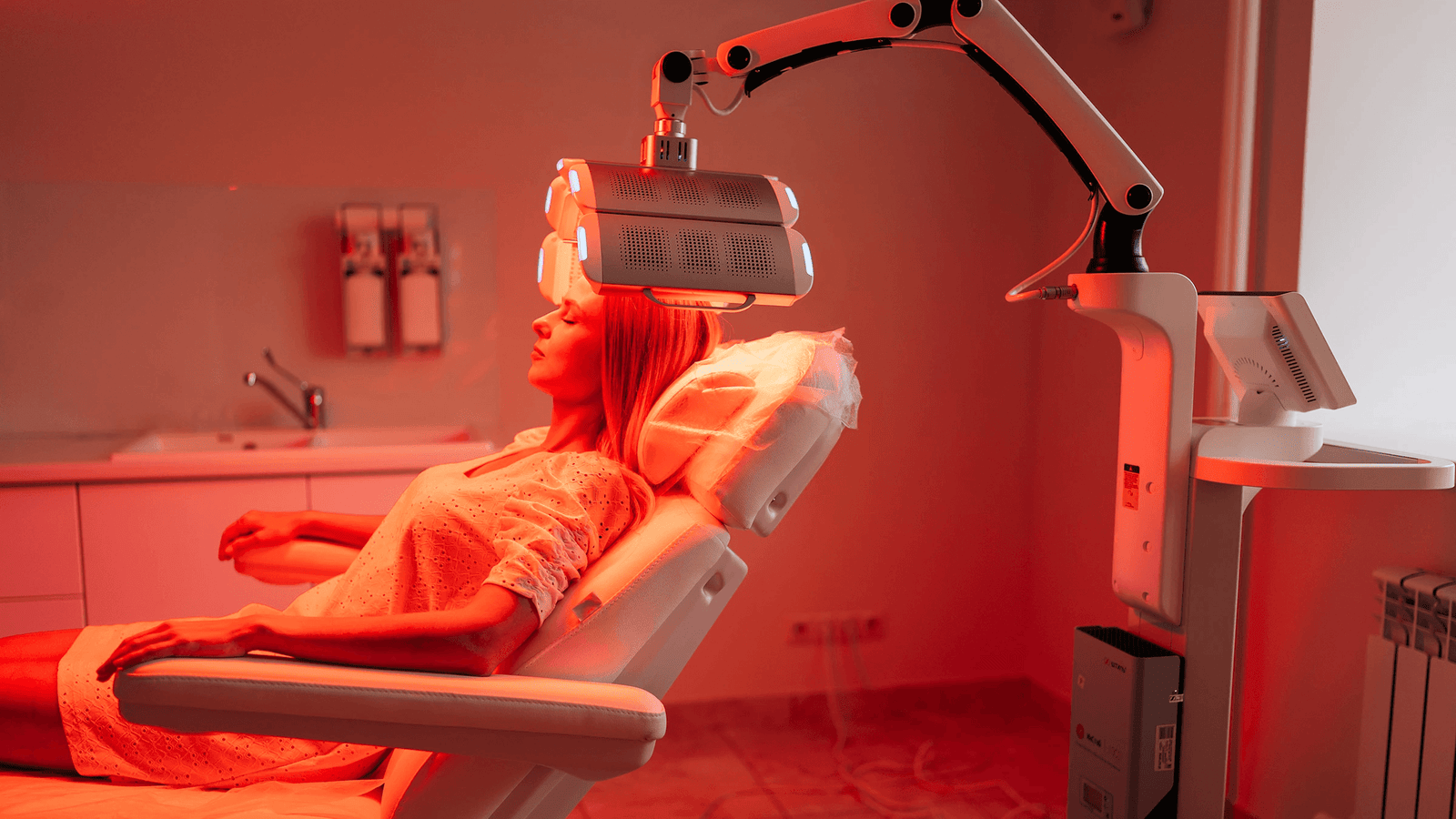
Red light therapy, known clinically as photobiomodulation, works at the level of the mitochondria. When red light reaches the cells around the follicle, it is absorbed by cytochrome c oxidase, the final enzyme in the mitochondrial electron transport chain. That absorption increases ATP production and releases nitric oxide, which improves circulation to the follicle.
What matters most is the effect on the hair cycle. Follicles move through anagen (growth), catagen (transition), and telogen (rest). In pattern hair loss, more follicles sit in telogen, and those still growing produce progressively finer strands. Red light appears to push follicles back toward anagen and hold them there longer. A 2021 study on cultured human scalp follicles found that 650nm light delayed the exit from the growth phase, leaving a higher proportion in anagen by day eight.
Red light therapy is not adding hair. It is changing the behaviour of follicles that are still alive but underperforming, which is why earlier intervention consistently works better.
Which Wavelengths Are Most Effective for Hair Growth?
Wavelength is the most important specification, because it determines what absorbs the light and how deep it travels.
For hair, the evidence concentrates tightly between roughly 630nm and 670nm. The 12-month trial published in Dermatologic Therapy used a device emitting 646 to 675nm, and the mechanistic follicle research uses 650nm. Most FDA-cleared home devices with published trial data sit in the same narrow window.
This runs against a common assumption. In skin applications, near-infrared around 830 to 850nm is well established for its deeper penetration. In hair applications, the direct clinical evidence is overwhelmingly red. Near-infrared has a plausible theoretical role, but the trials showing gains in hair count and density were generated almost entirely by red light in the 650 to 665nm range.
The most useful filter when shopping is whether a brand publishes exact figures. A device stating 650nm plus or minus 5nm is telling you something verifiable. One claiming clinically proven wavelengths without numbers is telling you nothing.
Why Dose Matters More Than Power
This is where buyers are most often misled, because the intuition is wrong. More power does not mean better results.
Photobiomodulation follows a biphasic dose response, documented extensively by Hamblin and colleagues. Too little light produces no effect, a moderate dose produces maximum benefit, and pushing past that point causes the benefit to decline. At high enough doses the effect becomes inhibitory. There is a therapeutic window, and a well-engineered device lands inside it rather than overshooting it.
Dose is irradiance, the power density reaching the scalp in mW/cm², multiplied by time. That produces fluence in J/cm², the figure that correlates with outcomes. A network meta-analysis found each additional 1 J/cm² per session was associated with a measurable rise in hair density.
This is why scalp irradiance figures that look modest beside a skin panel are not a weakness. Around 5 mW/cm² across a 10-minute session delivers roughly 3 J/cm², comfortably inside the range clinical hair protocols use.
Why LED Count Is the Most Overrated Spec
LED count is the number brands lead with, and the weakest predictor of results. The same network meta-analysis found the number of LEDs or laser diodes was not significantly associated with change in hair density. Count says nothing about how much light each emitter produces or where it lands.
Distribution is what matters. Any part of the scalp outside the emission field receives no treatment at all, so two hundred emitters concentrated over the crown will leave the temples and hairline untreated. Those areas will not respond regardless of how long the device is used.
Bands and combs cover one section at a time and need repositioning several times per session
Rigid helmets can sit away from the scalp on some head shapes, and that air gap costs delivered output
Lightweight caps are usually the most comfortable but tend to have the largest gaps at the sides and crown
Coverage is a design problem, not a component problem.
Why Consistency Decides Most Outcomes
Every specification above becomes irrelevant if the device does not get used.
Hair grows in cycles measured in months, so treatment has to be sustained across that period. Clinical protocols run three to five sessions per week over 16 to 26 weeks. One meta-analysis found lower treatment frequency performed at least as well as higher frequency, reinforcing that repeated stimulation over months beats intensity per session.
That makes wearability a performance specification rather than a comfort feature. A device that is heavy, conspicuous, or demands a 25-minute block of stillness gets used enthusiastically for three weeks and intermittently after that.
Based on a 12-month trial in which density rose from around 99 to 124 hairs per cm² over 48 weeks, the realistic timeline looks like this:
Weeks 6 to 8: reduced shedding, before any visible density change
Months 3 to 4: measurable density improvements begin to appear
Month 6 onward: shaft thickness improves and gains accumulate
Most people who conclude red light therapy did not work for them never reached month four.
Measured against these four variables rather than headline specs, the category separates fairly clearly.
The Glotech Hair Pro from LED Esthetics at $475 lines up most closely with what the research supports. Its 180 red LEDs run at 650nm plus or minus 5nm, placing it in the band where hair-specific evidence is concentrated rather than borrowing wavelength claims from skin research, and its published 5 mW/cm² over a 10-minute session delivers roughly 3 J/cm². The more interesting advantage is structural: the foldable panel sits inside a standard hat, so sessions happen during things already being done. Given that adherence decides most outcomes, that removes more friction than a larger spec sheet would. Its six-month guarantee is also the only return window here that spans the period over which results develop.
The alternatives each trade against one of the four variables, as the comparison below shows.
Device Price Light source Coverage Main tradeoff
Glotech Hair Pro $475 180 red LEDs, 650nm Full scalp, foldable panel Sells out regularly, direct only
iRestore Essential $499 Laser diodes plus LEDs Full scalp helmet Bulky, 25-minute sessions
HigherDOSE Hair Cap $449 120 LEDs Gaps at sides and crown Lower output
CurrentBody Helmet $860 120 LEDs Full scalp helmet Price relative to output
HairMax LaserBand 82 $849 82 laser diodes One section at a time Manual repositioning
Capillus Pro $1,699 Laser only Under-cap Cost versus performance
Is Red Light Therapy Safe for Hair Growth?
For most people, yes. The wavelengths used are non-ionising and non-thermal at therapeutic intensities and carry none of the risks associated with UV exposure. Adverse events across the trials referenced here were minimal or absent, and mild scalp warmth during early sessions is the most commonly reported response.
Red light therapy is well supported for androgenetic alopecia and diffuse thinning, and works on follicles that are miniaturising rather than gone. It is not the appropriate first-line approach for scarring alopecias, alopecia areata, or sudden stress-related shedding. Anyone taking photosensitising medication, managing an active scalp condition, or who is pregnant should speak to a healthcare professional first.
How long does red light therapy take to work for hair growth? Reduced shedding is usually noticeable within six to eight weeks. Measurable density improvements typically begin around months three to four, with shaft thickness continuing to improve past month six.
Can red light therapy make hair loss worse? There is no evidence that it accelerates hair loss. Some users notice a temporary increase in shedding early on, which reflects weaker hairs being replaced as follicles re-enter the growth phase.